| class | Anth 324: Sports and Society |
| dates | April 2025 |
| word count | 2300 |
This was my final paper for Sports and Society, a class that was hugely challenging to me and that I’m not sure I would have taken if I knew what I was in for. I wanted to develop a more formal and academic perspective on motorsports, which I had been considering as a thesis topic, and knew that the social and phenomenological aspects of sports in general would be covered. I was unprepared for the density and abstraction of the anthropological theory assigned to us and even struggled with the material to the point where I could not turn in a completed midterm paper as I had no idea what it was I was actually writing about. My professor was sympathetic and had faith in me to redeem myself on the final, which was incredibly kind and motivating in the wake of a demoralizing failure.
I took this class concurrently with an ecocritical art history class, and when I read Annie Gilbert Coleman’s article “Making Time and Place at the Indy 500″ I knew I had found my angle with the sensory and site-specific aspects of sport. In class, we had discussed American pastoralism as a characteristic of baseball, something that also holds true for the Indy 500 but in even more extreme contrast with the high speeds and technological innovation of the open-wheel race car. Spectators are also part of the sensory environment these sporting events take place in, a fact that’s underscored by the strangely quiet and almost non-canonical sporting events held without audiences during the Covid-19 lockdown. While not perfect, I feel this paper represents a triumph at the end of a class that challenged me greatly.
Spectacle as place-making and Americana identity at the Indy 500
The Indianapolis 500 is widely known as the “Greatest Spectacle in Racing,” a title that reveals its unorthodox attitude towards the label of ‘spectacle’ as a sporting event. John J. MacAloon, in his essay “Olympic Games and a Theory of Spectacle in Modern Societies,” describes a dialectic between the genres of festival and spectacle, particularly in the sense that spectacle is an undesirable but characteristic quality of the modern Olympics. The Indy 500, however, embraces spectacle as much as the IOC rejects it, resulting in a uniquely American atmosphere and mode of spectator engagement. Additionally, the atmosphere of the Indy 500 has become deeply ingrained into the specific place and time at which the race is held, indicating a vital quality of spectatorship reliant on physical presence and sensory affect. The 2020 running of the 500, which was pushed later in the year and held without fans, was unable to maintain the race’s festival or spectacle aspects without fans practicing the repetition of festival tradition or somatic, affective spectatorship. The disruption of festival and spectacle results in what MacAloon playfully calls “degenerating (de-genre-ating),” and prevents it from acting as an entry into the canon of Indy 500 celebrations.
MacAloon describes the IOC’s resistance to spectacle as a matter of taste: “Olympic officials have consistently regarded spectacle as an unfortunate accretion onto the Olympic performance system. In their view, spectacle is associated with tastelessness, gigantism, moral disorder, and the surrender of the high purposes of the Games to mere entertainment.”
Coubertin worried about the Olympics becoming “only theatrical displays, pointless spectacles.” The fear was that spectacle would strip the Olympics of their seriousness and gravitas in favor of “moral cacophony,” undermining their purpose as a “festival of human unity” and trivializing the efforts made to unite nations around the world in a celebration of human athleticism.
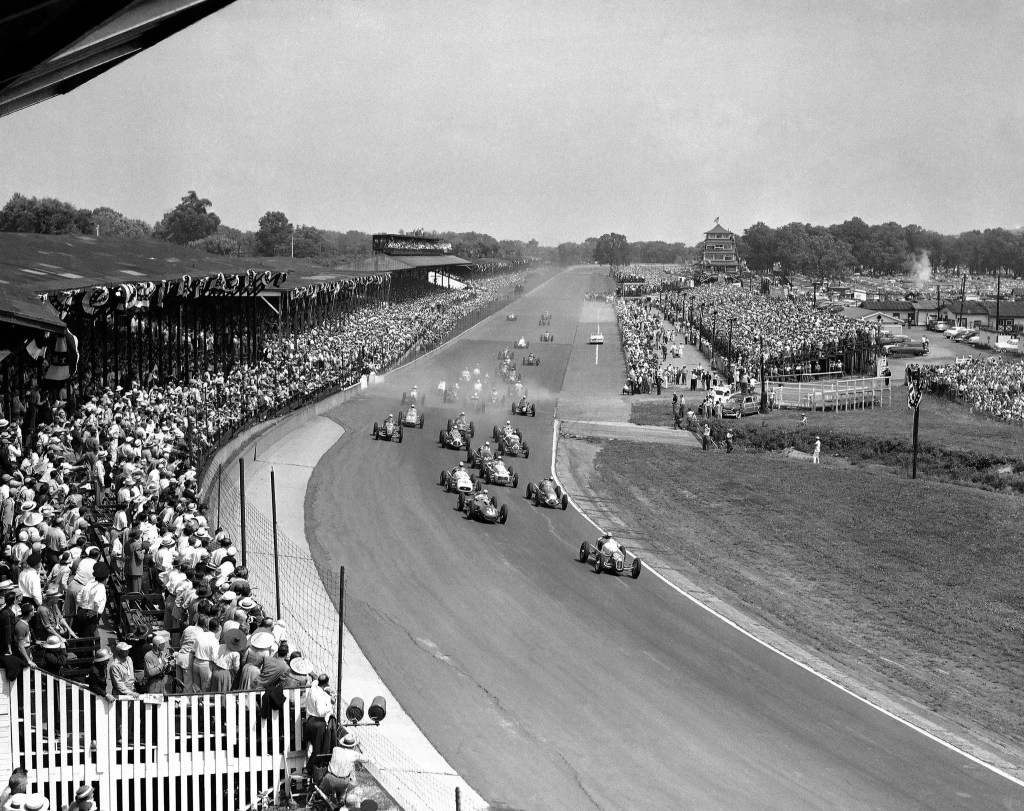
The Indy 500, as its aforementioned nickname suggests, is characterized by its spectacle. The Wikipedia page for ‘Indianapolis 500 traditions’ is longer than that for the Indy 500 itself (9600 words vs 7100). Wilbur Shaw wrote that the 500 “was a world’s series, a heavyweight championship fight, a National Open, a Rose Bowl game and a Kentucky Derby all rolled into one tremendous spectacle with a touch of the pomp and ceremony of a coronation.” Possibly validating the IOC’s fears, however, the spectacle of the 500 is not pure or spontaneous but instead historically corporate and commercial. Annie Gilbert Coleman writes:
“But the excitement of racing and all of its dangers soon spawned another layer of spectacle, this time created by race organizers specifically to attract more fans. In 1947 promoters convinced a different movie star each year to kiss the winner. Ten years later, they hatched the 500 Festival. Modeled on the Kentucky Derby festival, the one in Indianapolis soon grew to epic proportions. It started with a parade, a dance, and an invitational ball. By 1964 it was a weeklong celebration that included at least one golf tournament and a 500 Festival queen with four court attendants and twenty-eight princesses, and it culminated in a huge parade down the city’s main streets with thirty-three floats, school bands from across the state, and hundreds of thousands looking on. Now the city celebrates the race for the entire month of May.”
The draw of spectacle over festival as the primary mode of engagement for attendees of the 500 is its allowance for a greater range of emotion. MacAloon describes festival as reliably affective while spectacle is emotionally unpredictable, forcing joy in situations that may not invite it; “By requiring joyfulness, the festival frame cannot incorporate the very unjoyous, saddening, alienating, sometimes tragic events that have come to be part of the Olympic experience. Spectacle can do so for it specifies no further affect than diffuse wonder or awe.” Spectacle allows fans to deeply invest themselves emotionally in the action on track, as much as the drivers themselves. Embracing spectacle over festival means embracing earnestness over tastefulness.
Shore describes this kind of audience investment in the game action as “empathic engagement,” a kind of marginal play where spectators forget the boundaries of the magic circle that keep them outside of the game. He writes: “Spectators commonly find themselves caught up in game play. With strong kinesthetic involvement, they can easily forget that they are merely viewers. This is empathic engagement… Spectators come to experience a kind of flow within the game that is quite far from the reflexivity normally associated with spectatorship.”
Despair is a critical part of the experience of the 500, and the highs and lows of human achievement and emotion are felt by spectators and participants alike. Mark Knopfler’s “Speedway at Nazareth” recounts a driver’s struggles through a full season of IndyCar, culminating in finally winning a race after repeated failures. A full verse is dedicated to the 500, stressing its significance and the tribulation undergone by those who choose to face the challenge:
Well, the Brickyard’s there to edify anyone who will not learn
I climbed a mountain to qualify, went flat through the turn
And I was down in the might-have-beens, and an old pal good as died
Well I sat down in Gasoline Alley, and I cried.
Spectators understand the hardships faced by drivers in the Indy 500 because of the empathic engagement afforded to them by the 500 being primarily a spectacle and not a festival. Without the mandate of joyousness implied by a festival, spectators can suffer alongside participants and experience the same catharsis; resultantly, the 500 cultivates a level of passion and ardor among its audience virtually unseen in typical festival celebrations.
The desire to embrace spectacle also comes from the appealing dynamism of the contrast of high-energy, high-speed spectacle in a pastoral, agrarian setting. Jean Shepherd wrote in 1974, “To understand the 500, you have to have at least a faint whiff in your nostrils of those far-off times in the dreamy Indiana cornfields when the roar of a motor was as incredibly magical to the earthbound natives as space travel is to us today.” The incredibility of technological progress creates a sense of instantaneous history, of occupying a century of time passing in a single moment. Shore describes a similar historicity in baseball, where the sport inherently recalls its rural past; the baseball field maintains an illusion of pastoralism in urbanized settings; “Baseball has a way of resurrecting an agrarian past downtown.” The endless cornfields of Speedway, Indiana have been replaced with sprawling suburbs, but the pastoralism of the location is a crucial part of the 500’s identity. Coleman describes an archival photo from the 1919 running: “These cars from 1919 in Figure 2 were racing through an agricultural region, a nature defined in stark contrast to the automobiles moving through it. Modern technology met the rural Midwest right there, and no one at the Speedway has ever really forgotten that historical moment.” Her caption reads, “the racetrack binds the grasses and rural landscapes around it with another kind of nature: the fuel, steel, and rubber of the cars racing across it.”
Earnestly embracing spectacle as the primary mode of cultural practice and participation draws from the inherent spectacle of high-speed racing in pastoral, slow places and allows for empathic engagement by spectators where festival discourages it. The level of passion and energy afforded purely by spectacle results in an atmosphere unique to the 500, leading journalist Walter Troy Spencer to describe it as “one of the few truly indigenous folk festivals this country has produced.” Coleman concludes:
“Motion, speed, and sensory experience have much to do with how environments take material shape, acquire meaning, and become part of us—how we see and know nature, in other words. Going fast built the Speedway from a pasture; it also transformed a hulk of machine and fuel into human nerve endings, anchoring drivers to the earth. Going slow makes us bring out the rural nature beneath the track’s history, recall moments when bodies separated from machine, and revel in the sensual perceptions of spectacle, place, and region. Movement and technology converge hard at the Speedway.”
An added effect of the slowness-speed contrast of the Indy 500 is a somatic experience of spectatorship specific to auto racing events. MacAloon writes that “in its every aspect—from the etymology of the word, to the metamessage of the frame, to the sensory and symbolic codes it activates, to the behaviors it prescribes—the spectacle is about seeing, sight, and oversight.” However, the speed and power witnessed at the 500 is so overwhelming that the cars dominate perception in all senses. Seeing and sight become impossible in the face of everything else experienced. Coleman writes, “Screaming engines drown out every other sound. Cars flashing by at over two hundred miles per hour are indistinguishable from one another, and it is impossible to tell who is winning. Trying to focus on one car makes the rest of the world indistinguishable.”
The overwhelm of perception results in an alteration of time, where it is regulated instead to the passage of the race rather than real or everyday time. Shore describes an alteration of time by total investment in the circle of play: ““The time frame of games is carved out of the flow of time, a kind of sacred period set apart for play. Within game time, spectators and players alike are bound to the rules of play. As in baseball, game time is not always clock time.” For both driver and spectator alike, “Such extreme sensory experience erodes place and joins organic humans with machine. [Lyn] St. James agreed, stating that when traveling at full speed “it’s as if I’m becoming one with the car.””
Spectacle, festival, and tradition alike embed themselves in the physical space of the Speedway through repetition, what Coleman calls a “process of place-making.” She describes the track itself as holding memories (“especially where speeding drivers stopped”), reified and reinforced by acts of repeated memorial and reenactment. Ceremonies and stunts with banal or corporate associations become ritual after a century of repetition, as with the American Dairy Association-sponsored winner’s milk bottle. The Brickyard, Gasoline Alley, Carb Day are all terms whose literal definitions are obsolete but see continued use year after year. As with the inherent historicity of pastoralism as an aspect of the sport, “Ritual movements through the track and repeated performances of tradition have enabled fans to understand the 500 and its environment as at once historical and timeless.”
On March 26, 2020, IndyCar announced the postponement of the 2020 Indianapolis 500 from Memorial Day Weekend to late August; by August 4, they announced the race would be run without fans. All auxiliary events not directly relevant to the running of the race were cancelled, including the Carb Day concert, the Freedom 100 race, and the 500 Festival Parade. This would be the first running of the 500 outside the month of May, disrupting the rhythm of the annual festival celebration as well as affecting physical qualities of the track and environment. Without the presence of spectators and outside the traditional time of year, the 500 was stripped of the place-time elements that lent the race its atmosphere and degenerated its festival and spectacle aspects.
Interestingly, despite lifting the Indianapolis area blackout and being the only way to watch the race, the NBC broadcast of the 2020 500 had an all-time low Nielsen rating of 2.3, with only 3.67 million viewers (down 32% from 2019). MacAloon writes, “Though it has played a capital role in the spectacular quality and growth of the Games, television, even of the highest technical standard, reduces the spectacle to constricted little rectangles of color and form, systematically impoverishing the spectacle’s gifts to the human eye.” Both empathic engagement and the somatic experience of attending the race are greatly bolstered if not unique to physical presence at the Speedway, and television is unable to convey spectacle to a great enough degree to recreate those sensations of spectatorship. The lack of empathic engagement reportedly affected drivers, too: “One of the appeals of the Indy 500 has historically been the packed grandstands that come with the atmosphere of tradition that has permeated the track since the first running of the event back in 1911. Many drivers have expressed their sadness about not walking out of Gasoline Alley to find hordes of fans awaiting them.”
The 2020 race had to break from tradition in every way not directly relating to the race, decanonizing it as an entry into the annual festival celebration; lacking these elements strips the event of all phenomenological and festival significance connotated with the Indy 500. Spectacle is vital to the race in a way that cannot be conveyed without physical attendance, and the changes forced by COVID precautions revealed the importance of spectator presence in order to revive and reenact the traditions embedded within the physical space. Without the people, the time, and the place, what differentiates the Indy 500 from any other race?
Works Cited
Blackstock, Elizabeth. “Indy 500 Without Fans Is Right Decision For IndyCar.” https://frontstretch.com/, August 5, 2020. https://frontstretch.com/2020/08/05/indy-500-fans-2020/.
Coleman, Annie Gilbert. “Making Time and Place at the Indy 500.” Environmental History 16, no. 2 (2011): 322–35.
Knopfler, Mark. Speedway at Nazareth. Mercury. 2000.
Lewis, Jon. “Moved to August, Indy 500 Hits Record-Low.” Sports Media Watch (blog), August 25, 2020. https://www.sportsmediawatch.com/2020/08/indy-500-ratings-record-low-august-nbc/.
MacAloon, John J. “Olympic Games and the Theory of Spectacle in Modern Societies.” Rite, Drama, Festival, Spectacle: Rehearsals Toward a Theory of Cultural Performance. Philadelphia Institute for the Study of Human Issue, 1984.
Shaw, Wilbur. Gentlemen Start Your Engines. Coward-McCann, 1955. via Coleman.
Shepherd, Jean. “In Indiana, the Roar of the Motor Is Sweetest Sound.” The New York Times. May 26, 1974. via Coleman.
Shore, Bradd. Culture in Mind: Cognition, Culture, and the Problem of Meaning. Oxford University Press, 1996.
Spencer, Walter Troy. “The Indy 500 Is 300 Parts Babbittry, 100 Big Business, 100 Tradition.” The New York Times, May 21, 1972, sec. Archives. https://www.nytimes.com/1972/05/21/archives/the-indy-500-is-300-parts-babbittry-100-big-business-100-tradition.html.

