| class | Art 201: Intro to Art History |
| dates | November-December 2024 |
| word count | 2000 |
This paper was my first attempt at grappling with land art, permanence, and affect: it’s impassioned and clearly interested in approaching the question of justification from a number of perspectives but ultimately it’s all over the place and a little inconclusive. I think this project was more ambitious than the assignment called for (and I did get dinged for going over the page limit) but I learned a lot from the research and planning process and I built on these thoughts for the rest of my degree.
My project Fake Plastic Trees, which I did the following semester, approaches many of the same questions about permanence and human relationships with nature that this paper asks, but the format of that project made it essentially impossible to tackle site specificity, scale, or affect the way I tried to here. Additionally, neither project has the scope necessary to tackle the question of Indigenous land stewardship and the tensions between Heizer and his private properties and the displaced peoples of the desert Heizer occupies. This is the aspect of Heizer’s works that first drew me to examine the ethics of his practice and one I still don’t feel fully equipped to address until I visit City or Double Negative in person, and will inevitably be a research project I pursue indefinitely beyond college.
Heizer’s Earthworks and the Ethical Justification of Environmentally destructive earthworks
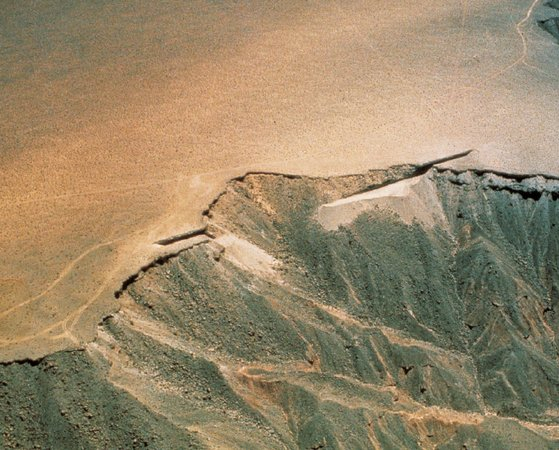
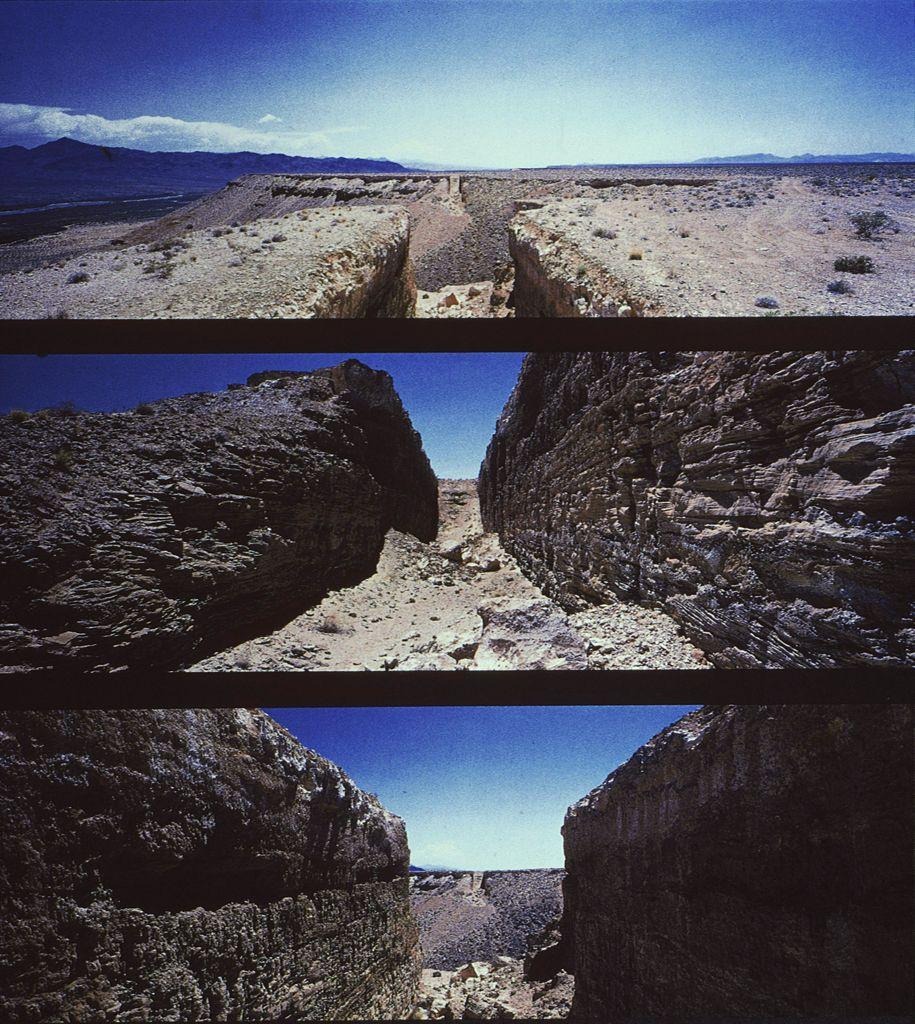
At what point, if any, can a work’s aesthetic, social, or affective contributions outweigh its own environmental impact? In 1985, Peter Humphrey questioned the legitimacy of permanently altering the natural landscape in the creation of earthworks, considering the ecological ramifications these works had on their environments. Michael Heizer’s Double Negative (1969-70) was one of the main targets of Humphrey’s essay, specifically for the amount of earth displaced to create it and its resemblance of marks left on the terrain by industrial mining operations. Humphrey, despite admitting to enjoying earthworks himself, did not address whether the value of Double Negative and other earthworks as works of art outweighed any negative effects they may have on the environment. As earthworks are uniquely affective—”permanent monumental sculptures in remote, inhospitable locations that ostensibly escape the art system and demand reverential pilgrimages to experience them in situ”— this may lend them increased power to act as an implicit call to action.
Heizer has stated that “[his work’s] meaning and raison d’être is its own existence—nothing more and nothing less;” instead, his work inspires a powerful and moving affective experience. The affect of Heizer’s work is in the viewer’s enlightenment to their own insignificance on a geologic scale (both in size and time). In his book on Heizer’s Effigy Tumuli (1983-1985), Douglas McGill described the “overwhelming” experience of standing within one of Heizer’s works:
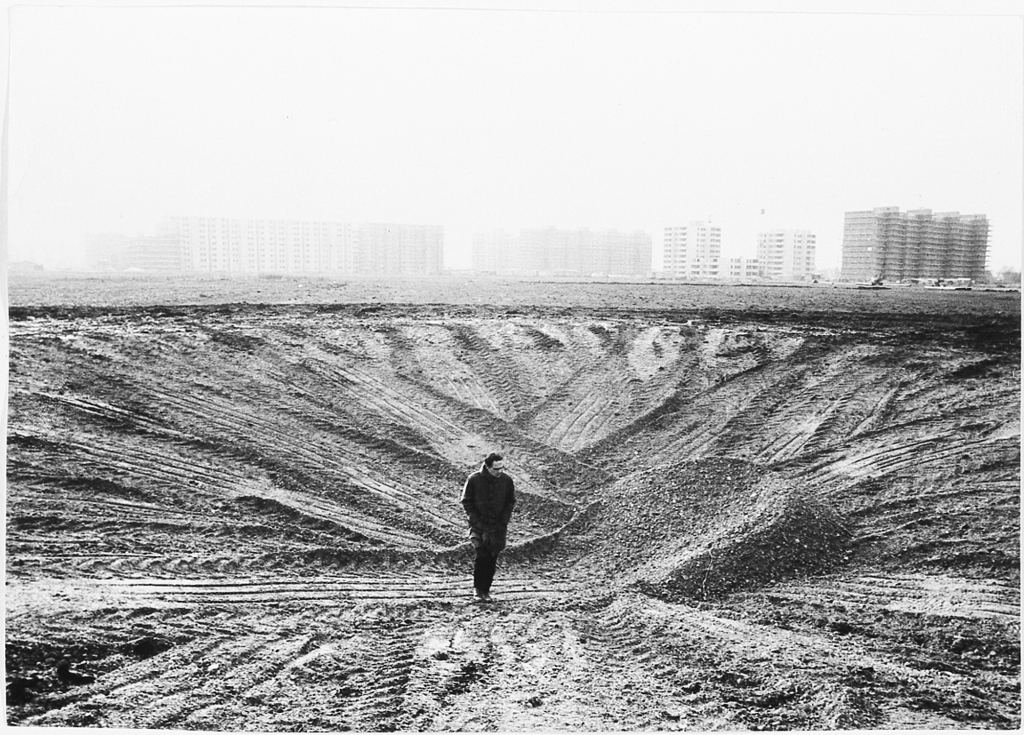
In their overwhelming size, many earth works attempt to challenge and even to obliterate an individual’s sense of self, in much the same way that a mountain or a river–or for that matter a skyscraper or an ocean liner–might do. A work can fill up an individual’s entire field of vision, and can even, in the case of many of Heizer’s works, completely envelop a person physically. The earliest earth work to express this idea was Heizer’s Munich Depression of 1969, a sixteen-foot-deep depression that was a hundred feet in diameter of gently sloping surface made in the countryside near Munich. When an individual stands at the bottom of the work, the surrounding landscape is entirely erased, leaving the viewer to confront only the gravel at his feet, the sky above, and his own imagination.
Heizer’s works encourage introspection and self-localization within the universe; Martin Hogue calls it “a sense of immediacy, indeterminacy, and insignificancy.” An individual experiencing a work such as Munich Depression or Double Negative is aware not only of themselves, but the vastness of their environment and the improbability of the amount of earth that has been moved in order to create this unnatural formation. This effect is apparently incommunicable (“No documentation can prepare one for the sensation of standing in those deep cuts and looking across a great divide to a mirror image of the place where one is standing”), transcendent (“The complete experience, for me, is of immediate connection with a universe far larger than our regularly imagined one, and yet more intimate”) and experienced even by Heizer himself (“Transfixed by the sublime possibilities of positive and negative space, he not only created a compelling work of art, but turned a naturally extant void, framed by a mechanized cut-out on either side, into a stark, decisive, and alluring feature of the landscape.”) Heizer’s work is uniquely and powerfully affective, and bolstered by its situation in its environment.
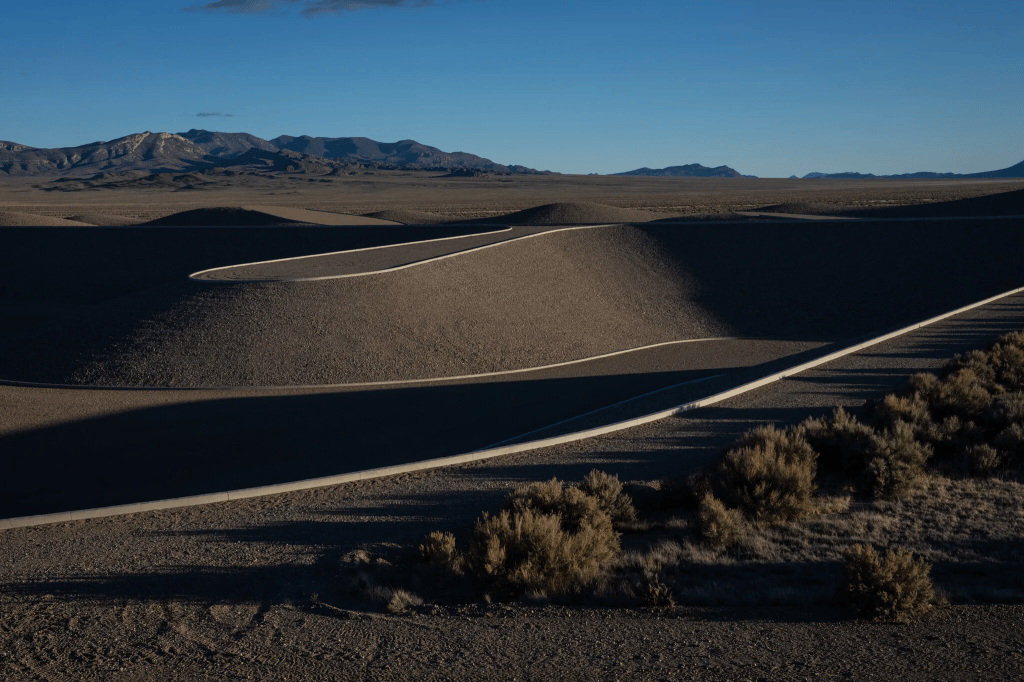
The desert location of Double Negative and City was specifically chosen by Heizer because of transcendent qualities inherent to the desert that contribute to the affective experience of the art. Heizer has stated that “the work is not put in a place, it is that place.” The desert is part of the entire work of art. Allen Carlson writes that the desert is “not ‘conventionally scenic,’ but ‘the scenic’ is a narrow and parochial construal of nature’s aesthetic and merit” and that the desert has a “subtle, quiet beauty of its own.” Hogue writes that the desert is an instance of a “marginal” site and that Heizer “severed connections to the art world and its institutions by seeking locations remote from major urban and cultural centers;” Boettger argues that Heizer chose the desert in order to directly compare Double Negative to the Grand Canyon; Menard says the desert “had long been considered a null or negative space…. Where it wasn’t overlooked or ignored, it was avoided,” and that Heizer’s mark on the land turned “hollow ground” to “hallowed ground.” Whatever Heizer’s reasons, the desert setting of his earthworks is an integral part of the experience and a conscious incorporation of a specific environment.
Heizer’s earthworks are scars on the desert landscape—by design. Heizer has spoken about his resistance to his works’ gradual decay, and revealed plans to refresh Double Negative’s walls with concrete in 1999. Scholars have argued that the permanence of Heizer’s earthworks only increases the severity of their ethical transgressions against the environment; Humphrey colorfully used the metaphor that “Dunking my friend in the pool is a prank; holding hirn under until he’s dead is wrong.” The incorporation of the desert landscape into the scope of the artwork, especially in a way that is permanent, is seen as exploitative and destructive of the wilderness. Ted Nannicelli states that “because environmental artworks appropriate part of the environment as an aspect of their identity, an aesthetic flaw in an environmental artwork necessarily also creates aesthetic disvalue in the environment—disvalue that exists in virtue of the creation of the artwork” and further that “the aesthetic flaws of an environmental artwork, which result in aesthetic flaws in the natural environment itself, are always ethical flaws of the artwork.” By this chain of logic, there is no possible way for Double Negative or any other transformative, non-ephemeral earthwork to be ethical; however, there is also an argument to be made that no earthwork is permanent due to the effects of nature itself. “Imposed natural forms succumb to inexorable natural powers.”
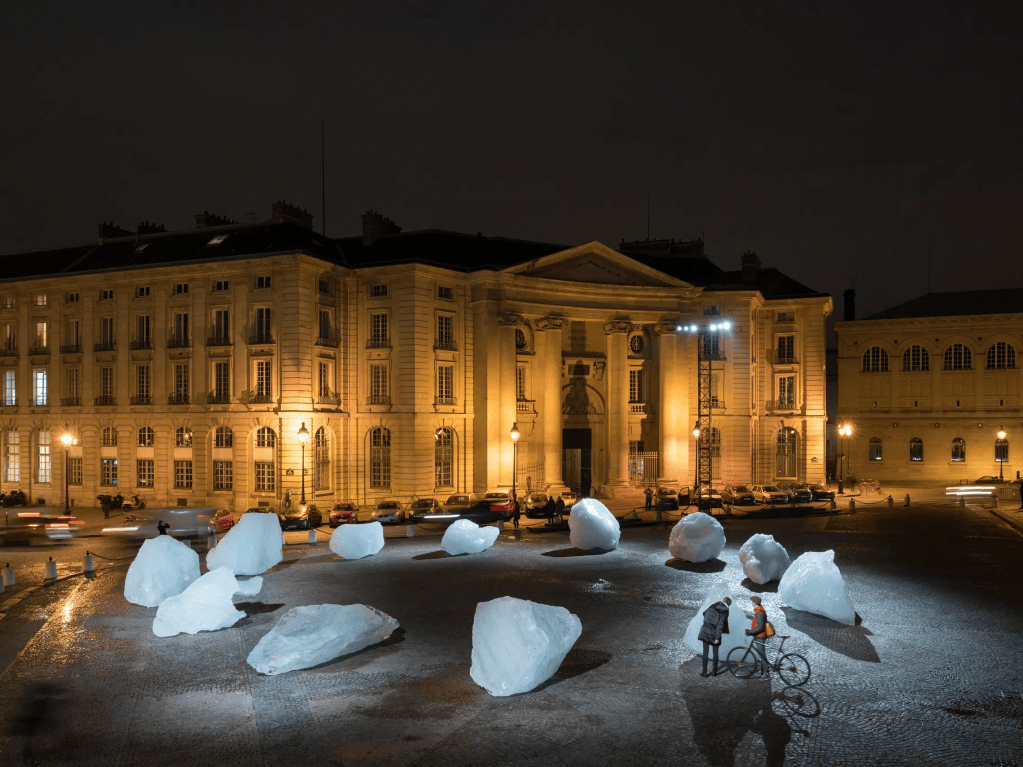
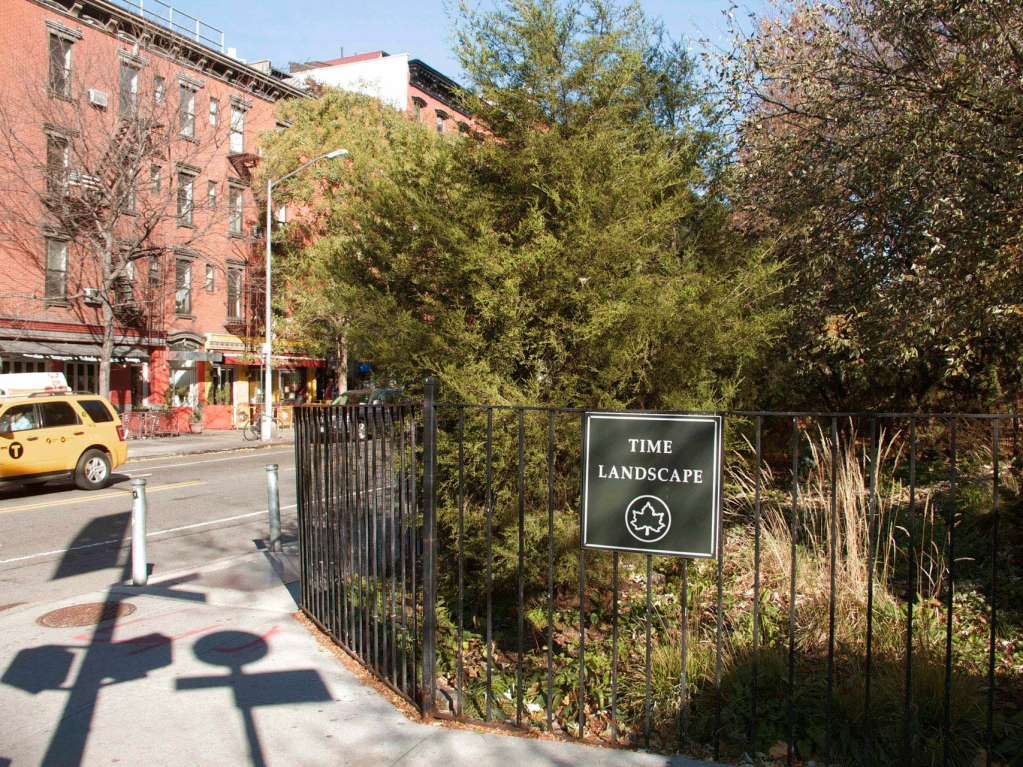
Earthworks may ethically justify their own existence if they inspire positive change. Art critic Elizabeth Baker claims that “these works, in their capacity as Art, may have a preservational effect;” indeed, Heizer’s contemporary Otto Piene sought to “reharmonize…the relation between man and nature.” Nannicelli discusses two earthworks with explicitly environmental messages that had vastly different carbon footprints themselves: Olafur Eliasson’s Ice Watch (2015) which involved harvesting twelve massive ice blocks from Greenland and transporting them to Paris, and Alan Sonfist’s Time Landscape (1965-present) which used native plants to recreate a pre-colonial snapshot of New York in the form of a garden plot. Heizer’s work, though absent of an explicit conservationist message, also reflects anxieties of modernization and destruction of nature: Double Negative resembles the remains of an industrial strip mining operation, while City reflects the rapid expansion and suburbanization of desert metropolises like Phoenix and Las Vegas. Neither are as urgent as Ice Watch, or present as clear a solution as Time Landscape, but perhaps their evocative imagery in tandem with their experiential effects may inspire Baker’s “preservational effect” in their audience.
Whether or not earthworks’ positive impact can outweigh their own negative impact, the affective nature of Heizer’s works requires that the audience has access to them. Due to the location of Double Negative and City in the remote Nevada desert, they are largely completely inaccessible to those unwilling or unable to drive out there themselves. City, in particular, restricts access to just six people a day, seventy two days a year, and only by lottery. Additionally, the effect of Heizer’s work is specific to the physical experience of seeing it in person; Dwan claims:
Earthworks must be experienced as actual, palpable structures. It is my hope that short excursions to these very real works will become a part of the lives of many people. The sense of space and time and one’s place in the universe they bestow is inherent and intrinsic to each of them and to each of us.
Heizer declined to participate in MOCA’s Ends of the Earth exhibit in 2012 due to the inadequacy of photography in representing his art. There is no form of mediation that can replicate the experience of seeing Heizer’s works in person, and therefore no way to increase access to their effect. Any question of ethical justification through positive change is nullified by their inaccessibility.
The initial question is therefore answered, if in a roundabout way: regardless of the magnitude of impact a viewer may feel upon seeing Heizer’s earthworks for the first time, the number of people who will have the opportunity to do so is so tiny that it doesn’t matter. There is no possible way for Double Negative to have enough of an effect on enough people that it offsets the irreparable damage it has caused to the Mormon Mesa, if its experiential affectiveness cannot be conveyed through mediated images. Additionally, the initial question of “outweighing” is inherently flawed: can any amount of preservation, reclamation, and conservation of the environment justify destroying it in the first place? Heizer seems ambivalent towards the environment and the conservation of, treating it more like his canvas than as a living habitat. Even if his earthworks do reflect modern anxieties, he offers no way to combat or reverse the trajectory the planet is on. Perhaps an artist more dedicated to the cause would be more successful in creating socially impactful earthworks; likely, such an artist would not create earthworks at all. For now, we have Michael Heizer’s permanent and sublimely powerful marks on the earth.
Works Cited
Boettger, Suzaan. “Earthworks’ Contingencies,” Ethics and the Visual Arts, Elaine A. King and Gail Levin, Eds., New York: Allworth Press, October 2006, 217-234.
Carlson, Allen. “Is Environmental Art an Aesthetic Affront to Nature?” Canadian Journal of Philosophy 16, no. 4 (1986): 635–50.
Chianese, Robert Louis. “How Green Is Earth Art?: Spiral Jetty.” American Scientist 101, no. 1 (2013): 20–21.
“City 1970 – 2022.” Accessed December 10, 2024. http://www.tripleaughtfoundation.org/.
Flam, Jack, ed. “Discussions with Heizer, Oppenheim, Smithson (1970).” In Robert Smithson: The Collected Writings. University of California Press, 1996.
Gruen, John. “‘There’s No Understanding of My Work’: Michael Heizer on His Monumental Art, in 1977.” ARTnews.Com (blog), June 26, 2015. https://www.artnews.com/art-news/retrospective/theres-no-understanding-of-my-work-michael-heizer-on-his-monumental-art-in-1977-4398/.
Hogue, Martin. “The Site as Project: Lessons from Land Art and Conceptual Art.” Journal of Architectural Education (1984-) 57, no. 3 (2004): 54–61.
Humphrey, Peter. “The Ethics of Earthworks.” Environmental Ethics 7, no. 1 (1985): 5-21.
Kaiser, Philipp, and Miwon Kwon. Ends of the Earth: Land Art to 1974. Los Angeles, USA; Munich, Germany: The Museum of Contemporary Art, Los Angeles, 2012.
Kimmelman, Michael. “ART/ARCHITECTURE; A Sculptor’s Colossus of the Desert.” The New York Times, December 12, 1999, sec. Arts. https://www.nytimes.com/1999/12/12/arts/art-architecture-a-sculptor-s-colossus-of-the-desert.html.
Kimmelman, Michael. “Art’s Last, Lonely Cowboy.” The New York Times, February 6, 2005, sec. Magazine. https://www.nytimes.com/2005/02/06/magazine/arts-last-lonely-cowboy.html.
McGill, Douglas C. Michael Heizer: Effigy Tumuli. New York: H.N. Abrams, 1990.
Menard, Andrew. “Cutting Edge.” The Antioch Review 75, no. 3 (2017): 301–12. https://doi.org/10.7723/antiochreview.75.3.0301.
Nannicelli, Ted. “The Interaction of Ethics and Aesthetics in Environmental Art.” The Journal of Aesthetics and Art Criticism 76, no. 4 (2018): 497–506. https://doi.org/10.1111/jaac.12601.
Ruwedel, Mark. “The Land as Historical Archive.” American Art 10, no. 1 (1996): 36–41.
Sonfist, Alan, ed. Art in the Land: A Critical Anthology of Environmental Art. 1st ed. New York: Dutton, 1983.
Appendix
- Heizer, Michael, 1944-. Double Negative Morman Mesa, Overton, NV. 1969-70. https://jstor.org/stable/community.13579570.
- Smith, William S. “One to One.” ARTnews.Com (blog), March 31, 2016. https://www.artnews.com/art-in-america/features/one-to-one-63152/.
- Kimmelman, Michael, Todd Heisler, and Noah Throop. “It Was a Mystery in the Desert for 50 Years.” The New York Times, August 19, 2022, sec. Arts. https://www.nytimes.com/interactive/2022/08/19/arts/design/michael-heizer-city.html.
- “Ice Watch • Artwork • Studio Olafur Eliasson.” https://olafureliasson.net/artwork/ice-watch-2014/.
- Alan Sonfist. “Time Landscape.” https://www.alansonfiststudio.com/install/time-landscape.

