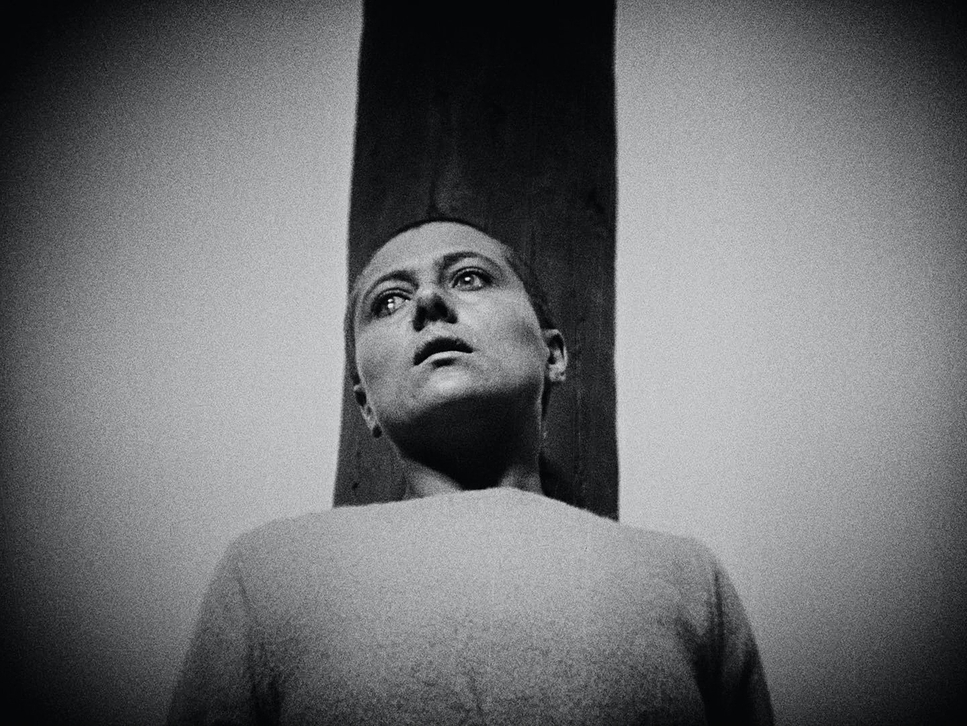
| class | FMST 201: Intro to Film Studies |
| dates | February 2025 |
| word count | 1200 |
This was a scene analysis for an introductory film studies class, for the unit on mise-en-scene, breaking down the visual language of a short sequence at the end of Carl Dreyer’s The Passion of Joan of Arc. This required an incredibly detailed shot-by-shot formal analysis of the entire sequence (~5 minutes) and a synthesis of the information gathered from this analysis in order to contextualize the sequence broadly historically, as well as to support a reading of this scene as the culmination of the film’s messaging surrounding Joan’s innocence, sanctity, and virtue.
I took this class relatively late in my film studies degree as a consequence of the program’s growing pains, so visual and narrative analysis in the medium of film was nothing new to me, but this specific paper helped me to develop and formalize a more effective and efficient workflow of film analysis that I applied through all my work in film studies throughout the rest of my degree. Additionally, I believe this paper demonstrates not only a deep proficiency in film analytical techniques but also that cultural literacy and interdisciplinary studies (in this case, my experience in art history) inform and bolster my arguments.
Virtue and Liberation in Passion’s Penultimate Scene
Before the climax of The Passion of Joan of Arc (Carl Theodor Dreyer, 1928), where Joan is burned at the stake, comes a quiet moment of prayer and contemplation as she takes in her last moments. Around her, the crowd grows more restless and the clergy begins to recognize the gravity of their erroneous judgment. This sequence, as Joan prepares herself for death, displays her innocence and charity to the audience and the onlookers and signals the liberation of her soul upon her death. The cinematic elements of this sequence serve to humanize her and demonstrate her virtue before her death makes her transcendent.
Joan is decentered throughout this sequence, occupying only the bottom half or the edges of the frame. Additionally, she is exclusively shown through medium or long shots, not the close ups the audience has become accustomed to. These choices both distinguish this sequence from the rest of the film as well as highlighting her youth and the magnitude of her responsibility. When Joan exits the church after her last communion, the blank white wall over the doorframe dominates the frame, weighing her down. Joan is tiny, and made even less imposing by the sackcloth she’s given to replace her men’s clothing. The arched doorframe forces her to hunch over and contains her form, and the guards’ spears further confine her. Only after an old woman crosses the boundary of the spears to offer Joan a drink is she allowed to walk alone to the stake. In stark contrast to her prior depiction, Joan is made small and vulnerable and relegated away from the center of the frame. Instead of the devoted servant of God defending herself in trial or the holy sacrifice, for the duration of this walk to the stake she is a scared teenager. It is only in the final shot of this sequence, immediately before the flame is lit, that she takes the center of the screen once again.
After praying but before having the cross taken from her, Joan shares a moment with an infant in the crowd. The baby, shown in close up in contrast to the more distant shots of Joan throughout this sequence, pulls away from its mother’s breast to look towards Joan. She looks back at the baby, who then turns back to continue feeding. This shot-reverse-shot includes both characters facing opposite directions on the same eye line, indicating eye contact. The moment of connection between Joan and the baby shows her own innocence and youth, and also suggests that her killing is so egregious that even the naive and innocent soul of an infant can recognize its wrongness. The image of the infant is reminiscent of the Nursing Madonna, an icon of the Virgin Mary that depicts her breastfeeding the infant Jesus. Though the mother is cut out of frame, the identification between the baby and Joan draws parallels between her fate and Jesus’s sacrifice, affirming her choice to accept death in service of God. As a result, this brief moment both grounds Joan in the real world and legitimizes her status as a holy servant.
Throughout the sequence, the members of the clergy are shown in increasing levels of distress. Though none of the three shots depicting them are true Dutch angles, they employ extreme low angle shots and disorienting composition to confuse the audience’s sense of the camera’s orientation. The first of the three, a long shot through a balcony railing, contains the clergy within what are reminiscent of prison bars as they all watch Joan’s procession. One man stands, leaving the boundary of the bars, and the cross on the roof of the church crowns the top of the frame. The second is shot nearly looking up from the floor, and shows three clergy members praying. All three are facing different directions, and the lines of the building behind them create additional angles that are not congruent with any of the monks’ eye lines. This shot starkly contrasts the simplistic composition of Joan’s last prayers to God, and portrays the Church as divided and unorganized. The third cements this divide, returning to the low angle shot through the bars. The man standing in the earlier shot faces left, hunched and praying, while the rest of the clergy files off screen to the right behind him. The clergy is left conflicted and guilty in the wake of Joan’s sentencing, and they become increasingly frantic in contrast to Joan’s quiet acceptance.
While Joan is being bound to the stake, the guard tying the rope drops one end; Joan leans down to pick it up and give it to him. Instead of rebelling or feeling angry at the man about to kill her, she allows and even helps him to carry out his duty. She understands obligation perhaps better than anyone else in the film, and does not fault the guard for carrying out his own. In picking up the rope, she also then contributes to her own binding and thus has a tiny sense of agency in her own death, which is further highlighted by the fact that this medium shot focuses on Joan’s face and not the guard’s. Later, when her hands are bound, a medium shot from Joan’s hip level shows the guard tying the last knots and cuts her head out of frame, removing her from the picture once the binding becomes an act done to her and not one she participates in. Even in her last moments, even in service of the man about to kill her, she demonstrates charity and offers her aid.
The entire sequence is intercut with footage of a flock of birds, which are shown to be directly representative of Joan through parallel editing and the use of repeated props. The birds are first shown in a low angle tracking shot following them flying toward and then landing on the cross on the roof of the church, which then cuts to a shot of Joan at exactly the same low angle. The cross looks exactly like the one Joan is given a moment later: dark iron with spherical decorative motifs at each point. After Joan is bound, the birds are shown flying away from the cross; the camera on Joan tilts slowly up towards the sky, and the birds are shown soaring across the open sky just before the fire is lit. Rather than using compositional parallels to connect the two, Dreyer cleverly maintains the camera angle between shots of Joan and the birds to create a sense of continuous gaze. Additionally, similar looking props create a tangible connection between the distinct shots. These match cuts foreshadow the fate of Joan’s soul as described by the final intertitle in the film: “the protective flames surrounded Joan’s soul as she rose to heaven.”
This sequence serves to characterize Joan as someone balancing vulnerability and youth with devotion and duty, and further highlights her virtue and empathy. This is shown not only to the audience but to the crowd of spectators, and as a result tensions grow as the clergy realizes their mistake. Through the use of composition, sets, props, camera angles, and parallel editing, Dreyer manages to convey the depth of Joan’s character and the tensions leading to the imminent riot with almost no dialogue.

