| class | Eng 271: Games, Play, and Stories |
| dates | November-December 2023 |
| word count | 4700 |
Shortly following the beginning of the lockdown in 2020, I started playing BioShock Infinite which I had always heard being highly regarded by game critics and enthusiasts. The subsequent experience was one of the most disappointing and frustrating blind playthroughs of a game I had ever had, and I stewed over my criticisms of the game for years. When I took a class on storytelling in games in fall 2023, there was no other option for my final paper than a profound and multifaceted critique of this game.
While the racial politics of Infinite were always a pain point, it was important to me to include a critique of the game’s usage of player agency and identification with the player character as that was the driving force behind the twist in its finale. I’m particularly proud of my invocation of the philosophical concept of transworld identity and the way it intersects with the critique of the story’s treatment of Indigeneity and Blackness.
If I remember correctly, the word count minimum for this assignment was around 1800-2000 words. I took another class with the same professor the following spring, and he had instituted a 2500 word count maximum for all assignments. Sorry, John!
“Wipe Away the Debt”: Constructed Identity and Player Culpability in BioShock Infinite
Upon the release of BioShock Infinite in 2013, Nick Cowen wrote for the Guardian that it “exists in a pantheon tagged “required reading” in the gaming medium. In much the same way as Heavy Rain or Dark Souls may not be to everyone’s taste, they are still important touchstones in the maturity of video games as an art form.” This level of praise was in part due to the fact that its story tackled serious topics such as racism, colonialism, and the cycle of violence. However, Infinite stumbles on all these topics, failing to understand in what contexts the use of violence can be justified and demonstrating hypocrisy in the way that it treats certain characters’ use of violence. Like many games, Infinite attempts to take advantage of its linearity to make a point about the role of the player in the actions of the player character; unfortunately, the game fails to commit to either holding the player accountable for their actions or allowing the player to enjoy the game without considering the morality of their actions.
In the fourth chapter of Janet Murray’s Hamlet on the Holodeck, titled simply “Agency,” Murray takes pains to stress that “activity alone is not agency” (161). While the player has the freedom to perform certain actions, “the players’ actions have effect, but the actions are not chosen and the effects are not related to the players’ intentions” (161). In other words, every option available to the player is prescribed by the game and affects the story in exactly the way intended with no opportunity for the player to affect the game in significant ways, such as by affecting the story. BioShock Infinite, being a game with a linear story, falls under this description and thus by Murray’s definition strips the player of agency.
Philosophical researcher Stefan Schubert, in his article “Dystopia in the Skies: Negotiating Justice and Morality on Screen in the Video Game BioShock Infinite” does not argue in favor of Infinite offering agency to the player but does elaborate on the interactivity afforded by the environment: “While BioShock Infinite’s gamescape can barely be interacted with, that is, it cannot be changed or manipulated, it can be explored by players, since many areas offer additional optional information on the history and inhabitants of the city, adding “background” to the narrative … The exploration of the game’s visuals largely forms part of the game’s optional aspects and its nonlinearity, since it offers players choices in how deeply they engage with these visuals” (3). This exploration also extends to the voxophones –audio recordings made by (major and minor) characters– scattered around Columbia, providing additional context and story as an incentive for exploration. The voxophones are an iteration of a narrative design philosophy described by the BioShock series’ creative director Ken Levine in a 2008 talk at the Games Developer Conference, called a pull narrative: “One form of pull narrative is found in objects that players have the option of picking up and that, if activated, deliver a segment of scripted narrative through written text, audio, or at times short movie sequences. These objects leave it up to the player to choose whether or not to engage with the material that is being related. According to Levine, this makes engagement with the scripted narrative of the game more powerful for those who decide to pursue it. Bioshock’s city of Rapture is strewn with tape recorders that contain brief audio vignettes related to the immediate environment” (Calleja 123).
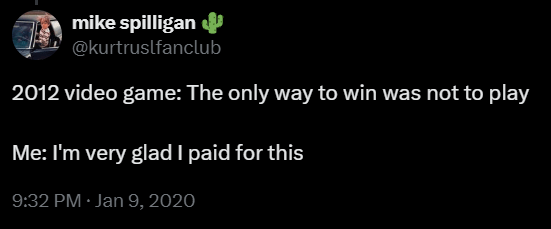
While Schubert’s interactive exploration does not fulfill the definition of agency laid out by Murray, it does feel free in comparison to more scripted, railroaded sequences in games with linear stories. As the entire opening sequence of Infinite contains no combat, the player feels free to explore every corner of the entire city they have been set loose in; even though there is a clear path to follow, there are things to find all over the place and the player can get a sense of what Columbia is like and what’s happening. As a result, the moment during the raffle in which the player is suddenly forced into combat feels like a loss of freedom and of choice. Infinite is not a game that offers players multiple avenues in which to approach encounters or solve problems, making it frustrating when characters within the game then choose to criticize the player for committing acts of violence. A 2020 Tweet by game designer Mike Blackney summarizes this narrative philosophy perfectly:
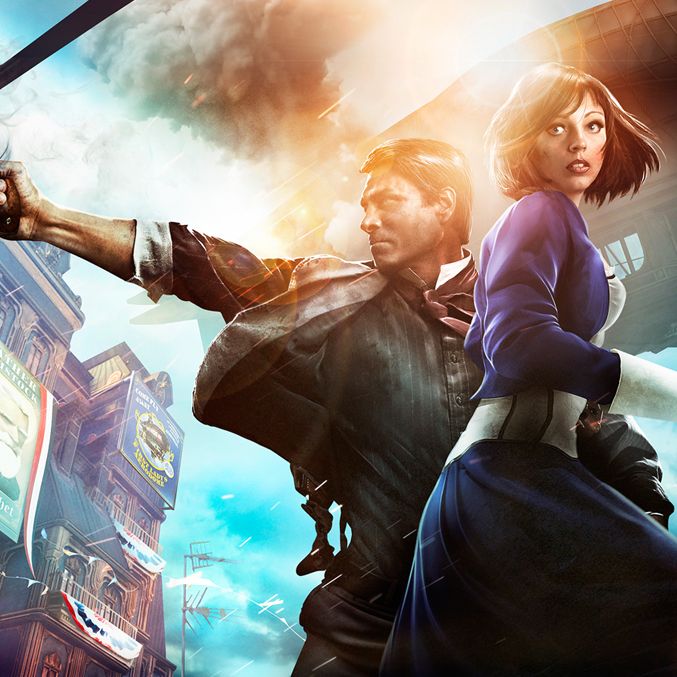
Though the issue can be illustrated clearly by individual scenes, Infinite’s problem with handling violence lies primarily in the player character’s own identity and past, explored in the larger overarching story. In BioShock Infinite, the player controls Booker DeWitt, a former Pinkerton agent instructed to “bring us the girl and wipe away the debt.” As Booker, the player discovers the floating city of Columbia and explores it in search of Elizabeth, who Booker quickly learns is the daughter of the religious figurehead and political leader of Columbia, Zachary Hale Comstock. Comstock is made aware of Booker’s presence and sends soldiers and war machines to prevent him from reaching the tower where Elizabeth is being held captive, but Booker soon frees Elizabeth and escapes with her. After rescuing Elizabeth, the game slowly turns its focus from Booker’s goal of bringing Elizabeth back to New York to complete the job and instead towards freeing Columbia from Comstock’s iron rule. In the process, Booker and Elizabeth learn more about the history of Columbia as well as their own deeply intertwined personal histories. The game culminates in the revelation that Comstock and Booker are actually the same person, brought together by portals connecting different realities together.
After escaping the tower, Booker and Elizabeth are intercepted at the gondola station by undercover agents working to recover Elizabeth on Comstock’s behalf, culminating in an ambush in the ticketing room. After the fight, Elizabeth is horrified by Booker’s actions: “You killed those people. I can’t believe you did that…they’re all dead…You killed those people! … You’re a monster!” This is the first time Elizabeth’s innocence and naivete concerning the world outside her tower are challenged, but it is also the first time that the player’s actions have been called out— after already having killed dozens of enemies. With this confrontation, the game is attempting to impose a sense of real-world morality on the player, jarring them out of the video game mindset and asking them to consider their actions. Booker immediately pushes back on Elizabeth’s accusations, telling her that it was the only way to ensure her safety. If the player chose to draw Booker’s gun on the clerk before the fight, Booker says, “One thing I’ve learned: if you don’t draw first, you don’t get to draw at all.” Booker is effectively convincing both Elizabeth and the player that his own use of violence is justified, setting a precedent that will be upheld throughout the rest of the game.
Booker is somewhat unique in being a player-controlled character who is not just a blank slate for the player to project on; his own past is critical in understanding his motivations and the entire story. Booker, being a fully realized character, has an entire fully realized past outside of what the player has experienced with him (albeit one he remembers only parts of for the majority of the game): namely, his actions during the (historical) Wounded Knee massacre hang over the entire game like a specter. Booker, having illegally joined the United States Army at sixteen years old, single handedly killed a huge number of people at Wounded Knee, lighting tents on fires with people still inside. Cornelius Slate, who served in the 7th Cavalry Regiment with him recounted that “DeWitt…we called him the White Injun of Wounded Knee, for all the grisly trophies he claimed” (032: A Soldier’s Death). Despite being honored by the Army for his actions, felt intense shame and guilt and sought to atone for his sins: as a result, Wounded Knee ends up being the catalyst for the events of the entire game. As explained by Frank Bosman in his analysis of redemption and baptism in Infinite:
Bioshock Infinite’s storyline revolves, among other things, around the theme of redemption. DeWitt wanders round in search of redemption for the atrocities he and his fellow soldiers committed against the Native Americans at Wounded Knee. When he meets Witting two years later, he is tempted to accept the preacher’s offer of redemption. When he accepts (R1), the baptism indeed brings a potential form of redemption for DeWitt: as Comstock, he is able to undo what he did before. Unfortunately for DeWitt-turned-into-Comstock, his transformation does not result in true redemption. Instead, Comstock makes the burden of his moral faults even greater by constructing a kind of religious dictatorial regime in Columbia. (Bosman 122)
One point of ambiguity that clouds insight into Booker’s motivations towards his actions at Wounded Knee can be discovered only by listening closely to the optional voxophone recordings: namely, the question of Booker’s heritage. In one recording, Comstock recounts what made him snap and commit the massacre:
“In front of all the men, the sergeant looked at me and said, ‘Your family tree shelters a teepee or two, doesn’t it, son?’ This lie, this calumny, had followed me all my life. From that day, no man truly called me comrade. It was only when I burnt the teepees with the squaws inside, did they take me as one of their own. Only blood can redeem blood.” (061: The True Color Of My Skin)
However, another recording recounts a meeting with Booker in an alternate universe where he became a figurehead of the revolutionary group Vox Populi:
“Mr. Comstock, when next we meet, it won’t be to parley. See, I went out to that Hall a’ Heroes to scalp your ‘False Shepherd’ for you. Turns out, though– DeWitt speaks Sioux. He helped me swap words with this cripple child I’ve been uh…looking after. Now after hearing how the kid has fared in your city– I’m thinking, when we take your pelt, I’ll let him hold the knife.” (053: Coming for Comstock)
The implication that Booker may be of Sioux heritage paints Comstock’s recounting in a different light, and would explain even further why Booker felt such crippling guilt for his actions. This information would reveal that Comstock’s glorification of whiteness is a construction created in the wake of Wounded Knee out of a sense of deep intrinsic shame and a need to prove himself, revealing Columbia’s racial segregation to be a compensation and a disguise for what Comstock considers to be an indelible and yet invisible flaw. By taking his racism to such an extreme, he removes any opportunity for his allegiance to his own whiteness to be questioned.
Booker’s indigeneity is entirely implied and yet casts shadows on his character throughout the game; similarly, the design of Infinite is implicitly colonial in a way that affects the messaging of the entire game. In striving to break away from the narrative conventions of video games but not ludic ones, Infinite frequently puts the player in situations where the narrative is undermined by gameplay mechanics and even exploits. Namely, Elizabeth’s characterization as a pacifist by circumstance of her isolated upbringing who is convinced by Booker that violence can be necessary in specific, dire situations is undercut slightly by her tendency to enthusiastically toss entire boxes of machine gun ammunition to Booker in the middle of fights, a mechanic that kicks in immediately after her conversation with Booker post-gondola station. Even more jarringly, Jodi Byrd expresses concerns over an exploit involving the Hall of Heroes, a museum glorifying Comstock’s role in the massacre at Wounded Knee and in the Boxer Rebellion, in which entering and exiting the building resets every vending machine in the area, allowing the player to farm money indefinitely. According to Jordan Clapper, “Byrd, in part, takes issue with the ahistorical representation of the massacre of Indigenous families at Wounded Knee, when the purpose of its carnivalesque presence in a “museum” is explicitly to ahistoricize this event to prop up white valor in a clearly genocidal act” (436). Byrd, writing about the role of Indigenous people within games on the code level says that “the Indian has little to no agency. It can be made to perform like an object under the right conditions, but it primarily serves as a baseline language through which all other objects achieve viability through reference in the system” (Clapper 435). Diegetically, the Indigenous figures inside the Wounded Knee exhibit are being used to valorize Comstock’s actions; in the real world, they are being sidelined and ignored in favor of profit and personal gain for the players. Clapper asks, “Do I assert indigeneity through such an act by subverting the game’s carefully crafted bioeconomic-correlative system, or does such an act only assert the whiteness of the character I play, a violent man able to break diegesis and become a money-machine?” Additionally, excluding the question of Booker’s heritage, these are the only overtly Indigenous American figures to appear in the entire game, functionally reducing the role of Indigenous people in this deeply American game to victims and cartoonish aggressors. The exclusion of Indigenous people in a story catalyzed by their deaths emphasizes their role as props in a story that is ultimately not about them at all.
Even more so than the plights of Indigenous people, Infinite concerns itself with Black liberation and violent uprising in a way that is implicitly and yet clearly from a white perspective. One of the first things the player learns about during their initial exploration of Columbia is the existence of the Vox Populi, a revolutionary group led by Daisy Fitzroy seeking to overthrow Comstock’s regime in pursuit of equal and fair treatment for the downtrodden working class. Booker first encounters Fitzroy and the working class near simultaneously when Elizabeth leaves him in Finkton, an industrial district of Columbia serving as both a massive workhouse and as a prison. Until this point, Booker has only been exposed to the shiny, colorful parts of Columbia occupied by the upper classes; this first foray into Finkton immediately reveals the injustice of Columbia’s class strata. Particularly noticeable is the fact that the majority of the people here are people of color, as opposed to previous areas where everyone was white except for a select few workers; however, this moment is not the first incident that calls into question race relations in Columbia. Earlier in the game, Booker enters and wins a raffle without knowing what the prize is– it turns out to be the opportunity to throw the first ‘stone’ (really a baseball) at an interracial couple tied to a display decorated with monkeys and a racist caricature of a black man. Schubert says of this scene, “The overall scene can thus be read as the “unmasking” of Columbia’s society, with Booker’s witnessing of this racial injustice serving as a catalyst for players’ realization that Columbia’s society is deeply flawed. That realization, in turn, is engendered both by the racist depiction of the interracial couple and by the framing of the entire scene, with Columbians shown as enjoying this public injustice—or, rather, their twisted idea of serving justice against an illegal union in Columbia” (7). For huge chunks of the game, there appears to be no reason not to sympathize with Fitzroy’s cause, which makes it all the more jarring when the game turns around and characterizes her as power-hungry and cruel, traits that make little sense for someone sincerely campaigning for equal and just treatment.
The game wants so badly for the player to believe that Fitzroy and Comstock are just as bad as each other that Booker and Elizabeth repeat that near verbatim what feels like dozens of times throughout the second half of the game. Even aside from the dialogue, the types of enemies the player fights from each side of the conflict are basically identical. In hammering home the idea that absolute power corrupts absolutely, the game ends up trivializing the entire uprising. Fitzroy, in ‘paralleling’ Comstock, becomes a caricature of a violent revolutionary, to the point of nearly killing a child for being the son of a tyrannical capitalist. The game refuses to engage with Fitzroy’s violent uprising, choosing instead to uphold the idea that pacifism is always morally superior and that violence as a means of upheaval in unjust societies is doomed to fail. With any amount of critical thought, the idea that a Black woman fighting for equal rights for herself and her working class comrades is equally as destructive as a xenophobic Christofascist authoritarian regime is ridiculous, and yet Infinite is so dedicated to its moral compass that it is forced to resort to turning Fitzroy to absurd levels of extremism to even vaguely prove its own point. Night in the Woods writer Scott Benson tweeted in 2017:

Infinite seems to constantly shy away from the question of whether Booker truly has the potential (in his current state) to become Comstock or even whether he has the same capacity for cruelty as Comstock. The avoidance is so severe that the narrative seemingly ends up singularly blaming Comstock for actions Booker himself did. Wounded Knee comes up again and again throughout Infinite as an example of the kind of brutality Booker is capable of, and foreshadowing for how Comstock came to rule over Columbia with an iron fist. As the impetus for the baptism that caused the divergence between Booker and Comstock, Wounded Knee acts as the equalizer between the two and demonstrates exactly how Comstock was able to take pride in his massacre and build himself a new identity out of it, while Booker stagnated in his conviction that there was no way for him to change the past or for him to move forward, especially after Anna’s abduction.
The blaming of Comstock for Booker’s actions is not limited to things Comstock also did pre-baptism: during the nineteenth chapter of the story, Comstock urges Booker to tell Elizabeth the truth about how she lost her finger during a confrontation inside the cabin of Comstock’s skyship. Booker, whose memories of Anna were erased when he came through the tear to Elizabeth’s reality, becomes enraged, slamming Comstock’s head on the edge of a water basin while screaming, “She’s your daughter, you son of a bitch! And you abandoned her! Was it worth it? Huh? Did you get what you wanted? Tell me! Tell me! … You cut off her finger…and you put it on me!” Even after regaining his memories of Anna’s abduction, Booker decides “this is all Comstock’s fault” and devises his plan to kill Comstock at birth to prevent him from ever founding Columbia or taking Elizabeth. In the final moments of the game, after Booker learns who Comstock is, he claims both identities:
Elizabeth 6: He’s Zachary Comstock.
Elizabeth 7: He’s Booker DeWitt.
Booker: No…I’m both.
However, even by claiming both identities, Booker doesn’t assume responsibility for Comstock’s actions; instead of atoning for both his own and Comstock’s sins, Booker is committing a heroic sacrifice to prevent Comstock from ever founding Columbia or taking Anna.
The introduction of the tears and the merging of different universes calls into question the individuality of the same person across different realities, as Charles Joseph Horn explores in his essay “BioShock Infinite and Transworld Individuality,” relating Infinite’s story to the philosophical concepts of transworld identity and essentialism. In the context of Infinite, the idea of essentialism is useful to determine to what degree Booker and Comstock are the same person, and the culpability of Booker for Comstock’s actions. Horn brings up the ideas of Antoine Arnauld in relation to Booker’s actions at Wounded Knee:
In the seventeenth and eighteenth centuries, the question of transworld individuality was absolutely crucial, not only for issues of freedom, but, even more importantly, for moral responsibility. The theologian and philosopher Antoine Arnauld (1612–94) held that individuals must be identical in different possible worlds or else we could not be punished or rewarded for our free actions. Arnauld would claim, for example, that Booker’s actions at Wounded Knee were free because there is also a possible world where Booker does not commit those atrocities. Most importantly, those two Bookers are identical to each other even though they exist in different possible worlds. Further, since the action was free, Booker can be held responsible for those actions. (Horn 78)
Furthermore, Horn says that “We can hold Booker responsible for his actions at Wounded Knee not because there is another possible world wherein he does not do those actions, but because Booker’s decision was self‐motivated; that is, it came from his own will” (79). Horn introduces a number of theories of essentialism in relation to transworld identity and to Booker: anti-essentialism, superessentialism, and counterpart theory. Anti-essentialism claims that no property of an individual is essential to them; “in short, Booker could lose all of his properties and still be Booker” (79). Conversely, superessentialism holds that all properties are essential to an individual. “If Booker did not commit the atrocities at Wounded Knee, then it would not be Booker” (79). This stance effectively absolves Comstock of anything Booker has ever done as an individual, and vice versa: a Booker who would choose to be baptized cannot truly be a Booker, and therefore anything Comstock has done before or after the baptism cannot be ascribed to Booker. Finally, counterpart theory exists in opposition to transworld identity: “Transworld identity stipulates that an individual x can exist in world W1 and an individual y can exist in world W2 and that x is identical to y. By contrast, counterpart theory stipulates that x and y are not identical in this case, but can be counterparts of one another depending on the strictness of our similarity relation” (80). What this means is that there is a margin within which Booker and Comstock can differ and still be the same person. This final theory seems to be the one Infinite wishes to ascribe to, but instead falls into the trap of considering the differences between the two to be so severe that Booker cannot be held accountable for Comstock’s actions.
In what seems like opposition to its linear narrative and prescribed characters, Infinite will occasionally afford its player the opportunity to try something and see what happens with no consequences. Illusion of choice frequently serves as freedom for the player to experiment without changing the story significantly, but in Infinite it manifests as freedom for the player to carry out unnecessary violence without consequences. Early in the game, Booker has the choice of throwing a baseball either at an interracial couple or at the announcer; though throwing it at the announcer seems like the obvious non-racist choice, there are no consequences for throwing it at the couple as Booker is stopped before he can throw the ball. Later, in the apocalyptic Shantytown where Vox Populi has successfully taken over Columbia, Booker encounters a group of homeless people fighting over a broken vending machine lying in the street. The people are not hostile towards Booker unless he takes the bag of money on top of the machine, at which point they will attack and Booker is completely justified in mowing them all down. Booker faces no consequences for killing a group of civilians and even gains money from it, rewarding the player’s curiosity while telling them that the collateral damage is meaningless. The actions the player takes in these situations never reflect on Booker himself, the game absolving him of responsibility either because it was the player’s prerogative or because neither scenario had any meaningful consequences.
The crux of Infinite’s hypocrisy regarding violence committed by Booker as opposed to violence committed by almost any other character is that the game cannot make the player feel bad for actions they were forced to commit as Booker. The consequence of the choice to have the player control a fully realized character like Booker DeWitt is that the lines between the player’s actions and Booker’s actions become blurred. Additionally, Infinite requires the player to engage in combat encounters to progress the story, meaning there is no way to play through the game nonviolently. As Horn says, “It would be very unfair, Arnauld would argue, to be held morally responsible for an action if one could not have done otherwise.” Furthermore, the game seems to recognize that the player’s embodiment of Booker will at some point become so extreme that any criticism of Booker’s actions outside of what he did while under the control of the player will still feel like an indictment of the player themselves, and accordingly becomes even more reluctant to question Booker’s apparent heroism in helping to overthrow Comstock.
Ultimately, BioShock Infinite is unable to meaningfully convey its themes regarding the morality of violence in any way because the game is incapable of holding its protagonist accountable for his actions. It asks the player to embody Booker as completely as they are able to, but cannot take the risk of making the player feel responsible for doing something morally wrong. As a result, Infinite is confused in its message and ends up allowing Booker to die an unequivocal hero, possibly even accidentally. Without the ability to use Booker’s own atrocities to prove its point, Infinite ends up limiting itself as a story and as a statement.
Works Cited
BioShock Infinite. Irrational Games, 2K, 2013.
Bosman, Frank. Accept Your Baptism, and Die! Redemption, Death and Baptism in Bioshock Infinite. http://www.academia.edu, https://www.academia.edu/33643130/Accept_your_baptism_and_die_Redemption_Death_and_Baptism_in_Bioshock_Infinite. Accessed 13 Dec. 2023.
Calleja, Gordon. In-Game: From Immersion to Incorporation. MIT Press, 2011.
Clapper, Jordan. “The Ancestors in the Machine: Indigenous Futurity and Indigenizing Games.” Alternative Historiographies of the Digital Humanities, edited by Dorothy Kim and Adeline Koh, Punctum Books, 2021, pp. 427–72. JSTOR, https://www.jstor.org/stable/j.ctv1r7878x.16.
Cowen, Nick. “BioShock Infinite – Review.” The Guardian, 26 Mar. 2013. The Guardian, https://www.theguardian.com/technology/gamesblog/2013/mar/26/bioshock-infinite-video-game-review.
Horn, Charles Joshua. “BioShock Infinite and Transworld Individuality: Identity across Space and Time.” BioShock and Philosophy, edited by Luke Cuddy, 1st ed., Wiley, 2015, pp. 76–85. DOI.org (Crossref), https://doi.org/10.1002/9781118915899.ch8.
Down Here For Your Soul [@bombsfall]. “my fav part of bioshock infinite was when the main guy says that the alt right are bad but on the other hand the alt left is the same” Twitter, 16 Aug. 2017, https://twitter.com/bombsfall/status/897638900805640193.
michael j foxney 🌵 [@kurtruslfanclub]. “@JustDiptych @bombsfall 2012 video game: The only way to win was not to play Me: I’m very glad I paid for this” Twitter, 10 Jan. 2020, https://twitter.com/kurtruslfanclub/status/1215506587441197057.
Murray, Janet Horowitz. Hamlet on the Holodeck: The Future of Narrative in Cyberspace. Updated edition, The MIT Press, 2017.
Schubert, Stefan. Dystopia in the Skies: Negotiating Justice and Morality on Screen in the Video Game BioShock Infinite. https://journals.openedition.org/ejas/14089. Accessed 13 Dec. 2023.
Wardrip-Fruin, Noah, and Pat Harrigan, editors. First Person: New Media as Story, Performance, and Game. MIT Press, 2004.

